Hello,
I'm Kaushik Paul
I'm interested in
About Me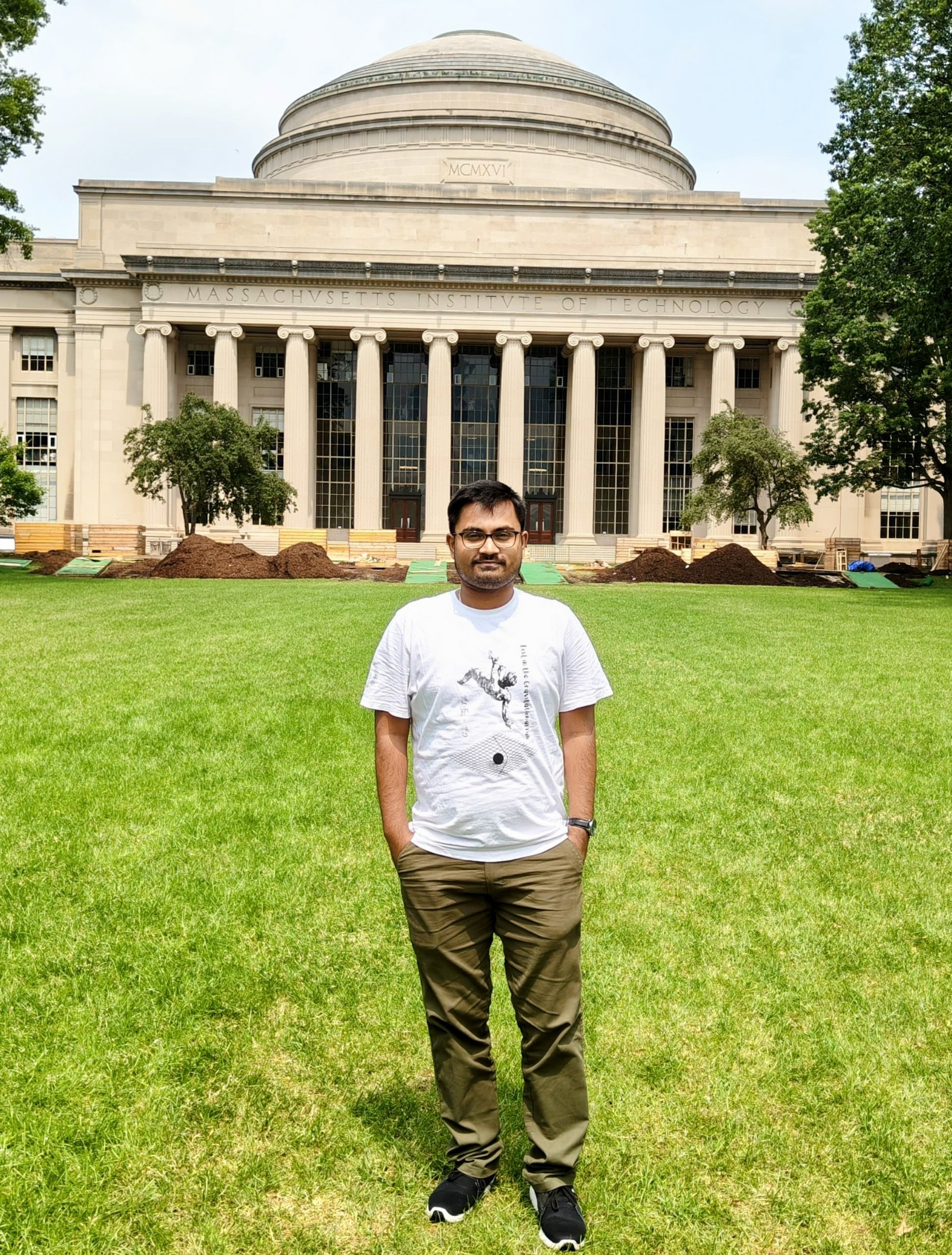

Hey there, thanks for visiting my website. I'm Kaushik Paul from Shyamnagar - a suburban place 31 kilometers from Kolkata, India. I did my schooling at Mulajore Sitanath Pathsala (10th) and Shyamnagar Kanti Chandra High School (10+2). I graduated with honours in Physics from Vidyasagar College (affiliated with the University of Calcutta) in 2016. Subsequently, I joined the Department of Physics, Visva-Bharati, for my Master's in Physics, which I completed in 2018. I obtained my Ph.D. degree in Gravitational wave astrophysics from Centre for Strings, Gravitation, and Cosmology, Department of Physics, Indian Institute of Technology Madras in 2025.
Early Career Scientistemail : kpaul.gw@gmail.com
place : Amsterdam, Netherlands
"I'm smart enough to know that I'm dumb." - Richard Feynman
Gravitational Wave Astrophysics
Focus Areas: Gravitational waves, Binary black holes, Post-Newtonian theory, Waveform modeling
Theoretical Physics
Focus Areas: Astrophysics and Cosmology
Physics (Honours)
Focus Areas: Classical Physics, Quantum Mechanics, Electromagnetism, Mathematical Physics
Currently, we are trying to improve the accuracy of ESIGMAHM model across the whole parameter space of mass ratio up to 6, dimensionless spins between (-0.9, 0.9), eccentricity up to 0.4 by adding Self-force (SF) corrections into the ESIGMA framework. It is well established that in high mass ratio regime Self-force results correctly describes the true dynamics of BBH mergers even if the gravitational field is strong, where PN theory breaks down. ESIGMAHM already had SF corrections in the radiation reaction sector for quasi-circular non-spinning binaries up to 6PN order. We found that including SF corrections improves the match values between ESIGMAHM and NR simulations significantly. As a first step towards this, we will be incorporating the circular spinning SF results in the framework and compare that version of ESIGMAHM with NR simulations. Eventually, our goal is to incorporate spinning eccentric SF corrections in the framework to improve the spinning eccentric sector of our model.
In the early stage of my Ph.D., my research focused on computing the aligned-spin effects in spherical harmonic mode amplitudes of the gravitational waveform for eccentric inspirals using post-Newtonian multipolar post-Minkowskian (PN-MPM) formalism.
It is well known that compact binaries tend to circularize when they enter the ground-based detector frequency band. However, binaries formed via dynamical interactions in dense stellar clusters or through Kozai-Lidov processes can have large residual eccentricities. Besides, orbital eccentricity is the cleanest feature to know about binary formation channels. The effect of the orbital eccentricity and spins of binary constituents are substantial on the gravitational waveform; neglecting it results in a low signal-to-noise ratio (SNR) while detecting a likely spinning eccentric candidate. Though the effect of eccentricity are explored separately, a combined treatment including spins and eccentricity is largely absent. Hence, it's very important to compute these effects on the gravitational waveform to understand the spinning eccentric inspirals.
The computation of spin effects in spherical harmonic modes of the gravitational waveform for eccentric inspirals involves source multipole moments and equations of motion of the system. The source multipole moments characterize the system properties and are functions of relative separation, relative velocity, and spins of the binary constituents. Taking source multipole moments and equations of motion as inputs, we compute spin effects in spherical harmonic modes valid for generic orbits within PN-MPM formalism. Next, we use generalized quasi-Keplerian representation to specialize these modes to elliptical orbits. I completed this project with my Ph.D. supervisor Dr. Chandra Kant Mishra and it is now published and can be found in arXiv:2211.04155.
Next, my focus was to use the analytical expressions derived in arXiv:2211.04155 and build a ready-to-use waveform model that includes effects due to spin, eccentricity and high-order modes for the detection of eccentric binary black hole mergers (BBHs). The waveform models like SpinTaylorT4, IMRPhenomXHM, IMRPhenomXPHM and SEOBNRv4, SEOBNRv4HM, SEOBNRv5 include the spin effects and EccentricTD, EccentricFD, TaylorF2Ecc (with quasi-circular spins) include eccentricity effects separately; however, a full IMR reviewed waveform model that incorporates all these effects simultaneously, is absent. In collaboration with Dr. Prayush Kumar (ICTS-TIFR), we presented ESIGMAHM: a time-domain, spinning eccentric IMR waveform model with higher-order modes for the detection and characterization of eccentric BBH mergers in arXiv:2409.13866.
I also contributed to a project where we computed the spinning eccentric corrections in GW phase up to 3PN order in small eccentricity limit. We obtained these corrections in various Taylor approximants: TaylorT1, TaylorT2, TaylorT3, TaylorT4, and TaylorF2. We have implemented the eccentricity expanded (up to 2nd order in eccentricity) spinning corrections up to 3PN in TaylorF2 phase in LALSuite with the approximant name SpinTaylorF2Ecc. The preprint of this work can be found at arXiv:2412.10909.
During my M.Sc., I worked on "The Halo Model Of The Large Scale Structures Of The Universe" under the supervision of Dr. Biswajit Pandey. In this project, I reviewed the Halo Model that divides all the masses of the Universe into distinct chunks called Halos. I learned about large-scale structure formations and various approximations used to explain their formations. I calculated the probability of Halos lying between specific mass ranges using the NFW (Navarro-Frenk-White) profile.
Source modeling, post-Newtonian theory, Gravitational self-force theory, Numerical relativity, Parameter estimation of GWs, and Tests of General Relativity.
Source modeling, post-Newtonian theory, Gravitational self-force theory, Numerical relativity, Parameter estimation of GWs, and Tests of General Relativity.